
Stem separation in Python without PyTorch: ONNX Runtime and DirectML
How stemma runs HTDemucs, MDX-Net and beat tracking locally on Windows GPUs and CPUs without shipping the PyTorch runtime.
- python
- onnx
- directml
- audio
- dsp
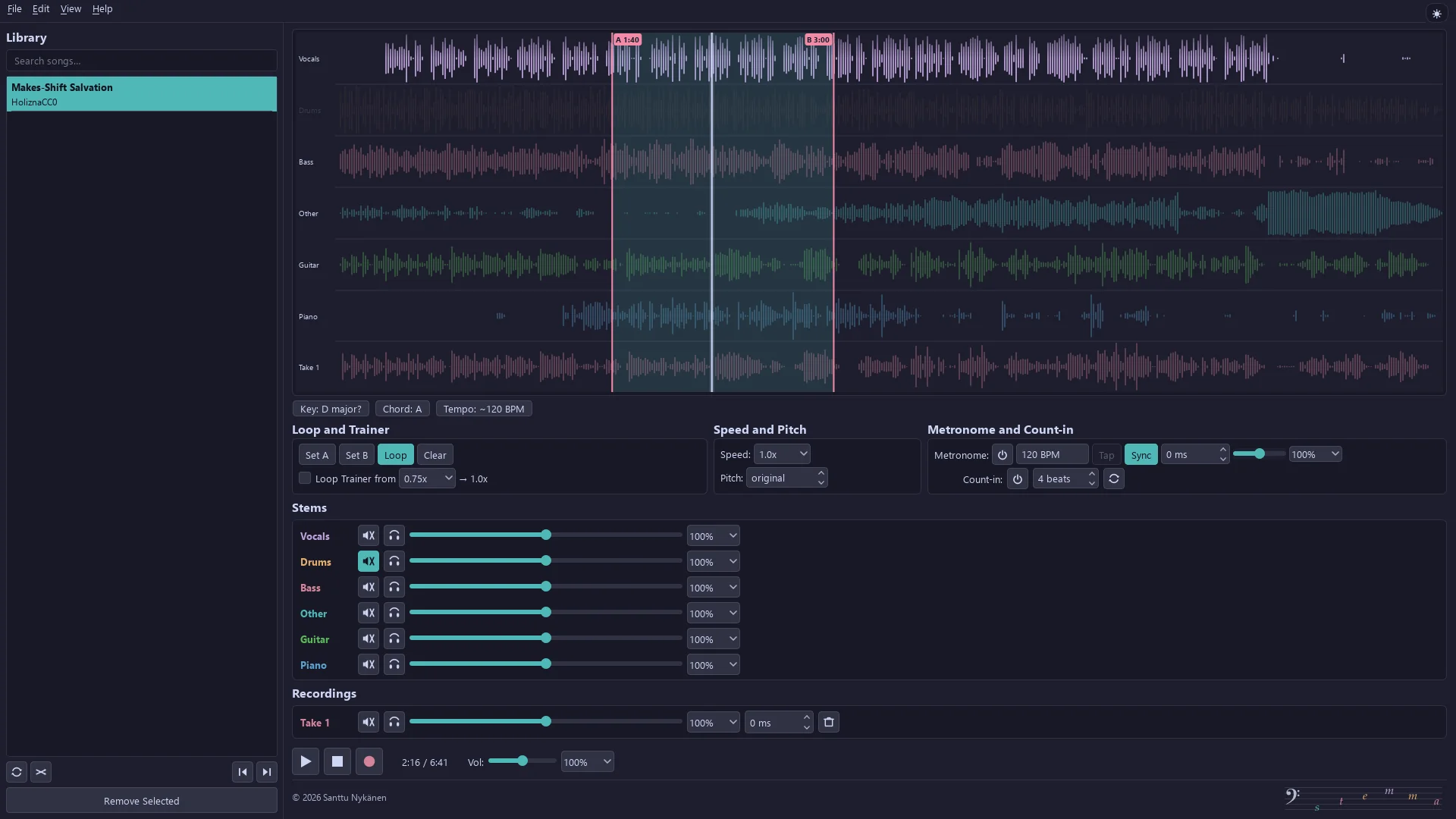
Audio ML in Python usually starts with pip install torch. For a desktop app, that means shipping a large runtime and still only getting GPU acceleration where that runtime supports the user’s hardware.
For stemma, I wanted stem separation to run 100% locally on a regular Windows machine without forcing users to install Python, CUDA toolkits, or a massive PyTorch runtime. Running inference on ONNX Runtime with DirectML from the start kept it a regular desktop app, with GPU acceleration where it works and a clean CPU fallback.
Moving STFT and iSTFT out of the model
In stemma’s converted models, the spectral transforms live outside the .onnx graph. Signal preparation happens in Python, where NumPy handles it predictably:
- HTDemucs v4 (
src/separator.py): Runs both the four-stem (vocals,drums,bass,other) and six-stem (addingguitarandpiano) models, doing all STFT and iSTFT pre- and post-processing in NumPy around the ONNX graph inside a backgroundQThread. - MDX-Net (
src/mdx_separator.py): Splits vocals and backing (other), managing STFT packing, windowing, context trimming, and overlap-add reconstruction in NumPy with zero PyTorch dependency.
Model files stay out of the installer entirely. On first import, src/model_manager.py fetches the converted ONNX artifacts, checks their SHA-256 hashes, and atomically publishes them into the user’s app data directory.
DirectML in practice (src/onnx_session.py)
DirectML gives ONNX Runtime a vendor-neutral Windows GPU path across AMD, Intel, and NVIDIA cards, though configuring a session takes a few guardrails learned the hard way:
- Defer the heavy import.
onnxruntimeis imported lazily insidecreate_onnx_session()because it’s heavy and only needed once inference actually runs. - Meet DirectML’s session requirements. When
DmlExecutionProvideris available, sessions setenable_mem_pattern = Falseandexecution_mode = ort.ExecutionMode.ORT_SEQUENTIAL, ordering providers as["DmlExecutionProvider", "CPUExecutionProvider"]. - Know when to skip the GPU.
create_onnx_session()takes ause_gpuflag. MDX-Net requests DirectML first and transparently falls back to CPU if session initialization fails—surfacing"DirectML GPU"or"CPU fallback"directly in the import progress status. HTDemucs passesuse_gpu=Falseand goes straight to CPU, because the current four- and six-stem ONNX exports fail graph compilation on DirectML (tracked in issue #125); skipping the doomed GPU attempt avoids both wasted startup seconds and console error spam. - Distinguish corrupt downloads from hardware limits. A generic fallback would hide broken model caches.
is_damaged_model_error()recognizesInvalidProtobuf,NoSuchFileandInvalidGraphfailures (plus external-data and protobuf parse text), and when the CPU session hits one,create_onnx_session()raisesModelDamagedError. The UI then says the model was removed and asks you to import the song again to download a fresh copy, instead of masking the corruption.
Cleaning up bleed and keeping time in NumPy
Once the neural model produces raw stem waveforms, a few lightweight DSP stages finish the job in pure NumPy and librosa:
- Bleed reduction (
src/post_processing.py): Runs in ~10-second chunks to keep memory flat, computing magnitude-based Wiener soft masks across stems followed by an RMS-envelope soft gate that trims faint ghost bleed during silent bars. - Beats, keys, and chords (
src/beat_detector.py): Uses chunked inference on thebeat_thisONNX model for BPM and downbeat tracking, Krumhansl-Schmuckler profiles for key detection, and Viterbi-smoothed chroma for live major/minor chord readouts. - Real-time speed and pitch (
src/stretch.py): Changing tempo or transposing ±7 semitones while practicing happens live inside thesounddeviceoutput callback via a NumPy phase vocoder (with identity phase locking so the mix holds its level) andsoxrresampling. Nothing has to be pre-rendered to disk when you drop a loop down to 0.75× speed.