
Porting a 2D Godot walk into Three.js without blowing up draw calls
Notes from building the interactive /walk seafront on this portfolio: translating pixels to meters, merging geometry with DirectBuilder, streaming districts, and porting the leash tests.
- threejs
- typescript
- webgl
- physics
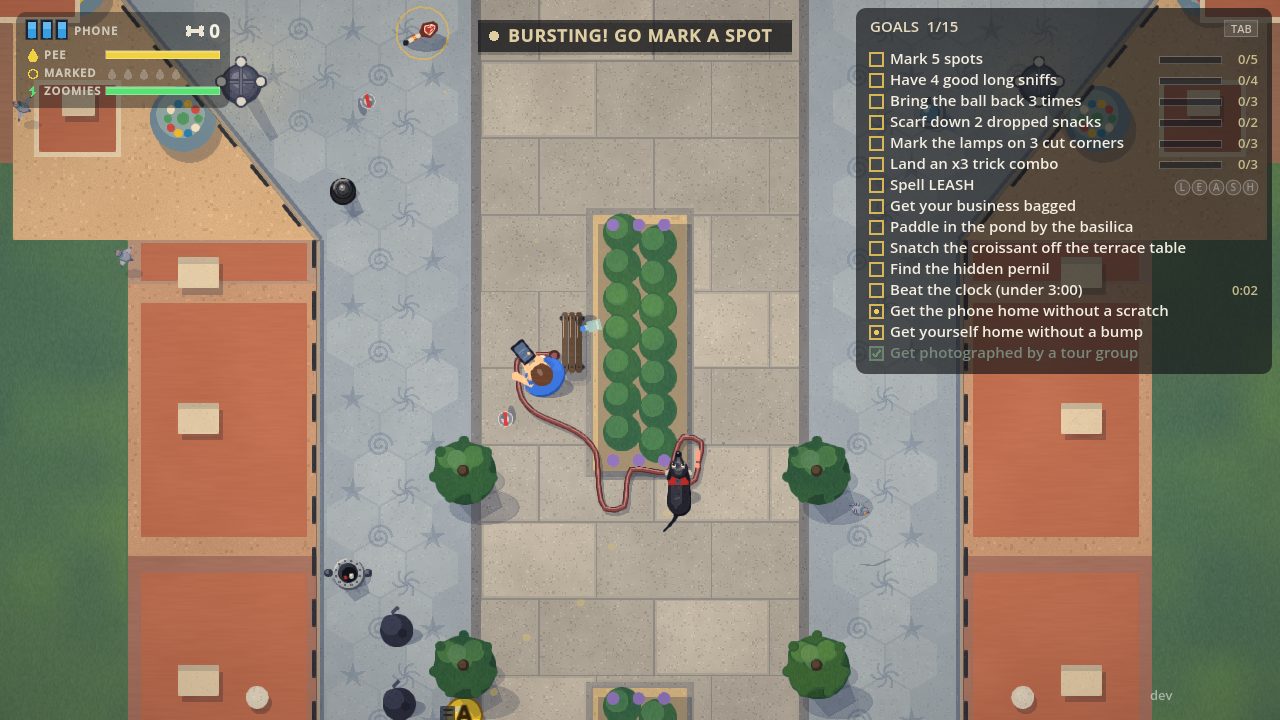
Path of Leash Resistance lives on the portfolio site as a 2D canvas street on the home page and a 3D walkable Catalan seafront town at /walk. Bringing the seafront, town blocks, market square, and hillside into a browser WebGL canvas without bundling external 3D art meant solving two problems early: physics scale and draw-call discipline.
Translating pixels to meters (68 px = 1 m)
The 2D Godot game measures a 340 px retractable leash in screen pixels and steps at 60 Hz. In src/scripts/walk/leash.ts, the XZ simulation rescales to meters (68 px = 1 m, giving a 5 m leash) and steps at 120 Hz.
Two small porting details made the biggest difference in feel:
- Segment-side anti-tunneling for 3D lampposts. In 3D, a thin spot mast (
r = 0.06 m) sits between 0.2 m Verlet vertices. Without checking which side of the pole each segment started on (pushSegment()), a fast sprint pulls the rope straight through the post. - Unconditional locking was too strict. When I later ported Godot’s wrap and slip-off checks into
tests/leash.test.ts, the “hard pull-away slips the coil off” assertion failed at first: keeping side-locks active at extreme stretch prevented wraps from sliding off. RelaxingpushSegment()side-locks above1.35xstretch and during activewhirl/freeSlipkept thin-pole anti-tunneling intact during normal pulls while letting overstretched wraps unwind cleanly.
Keeping WebGL draw calls flat in code
Everything in /walk is built procedurally—panot textures, plaster walls, signage canvases, buildings, palm trees, bicycles, and characters. Spawning separate THREE.Mesh objects per brick, step, and window frame would stall mobile GPUs fast.
Three rules kept the scene around ~650–700 draw calls on desktop even with multiple districts loaded:
- Direct merged triangle builders (
meshbuilder.ts). Static city blocks, terrain grids, and simplified distant stand-ins emit non-indexed triangles directly into vertex-colored chunk buckets viaDirectBuilderinstead of allocating thousands of temporaryBoxGeometrymeshes. - Sliced generators and frame budgets (
world.ts,bake.ts). Heavy builds (buildLevelSteps(),makePlazaDistrict(),makeHillDistrict()) yield as generators behind the train/metro loading screen and under a 4 ms streaming budget (Streamer), swapping distant stand-ins for live baked chunks when Millie gets within 80 m and unloading beyond 170 m. - Line-of-sight dither (
fade.ts). Instead of snapping walls invisible between the street camera and Millie, custom shader fading dithers geometry along the camera-to-dog ray while exempting characters and the red leash.
Splitting the runtime loop
As districts and interactive project pavilions (Coriolis, stemma, Eat Prey Nap, dopepod) accumulated inside game3d.ts, the orchestrator grew past 3,000 lines. Extracting particles.ts, sky.ts, goals.ts, and boothPanels.ts alongside automated unit tests (tests/leash.test.ts) and a headless CDP smoke check (tools/smoke-check.mjs) brought the 3D showcase closer to the engineering guardrails of the real game.